Mastering the 3D Laser Engrave Ship Wheeler: A Practical Guide for Creators
The landscape of digital laser engraving has evolved significantly, moving beyond simple line art into the realm of complex grayscale shading and depth. Among the many designs available to hobbyists and professionals alike, the 3D Laser Engrave Ship Wheeler stands out as a specific, high-fidelity resource designed to push the capabilities of modern desktop laser systems. This design is not merely an image; it is a technical asset prepared in high-quality resolution to function as a direct input for devices like Glowforge, xTool, and LightBurn-compatible machines. Understanding what makes this file distinct, how it compares to other formats, and when it is the right tool for your project requires a look at the technical specifications and practical applications involved.
Defining the 3D Laser Engrave Ship Wheeler Format
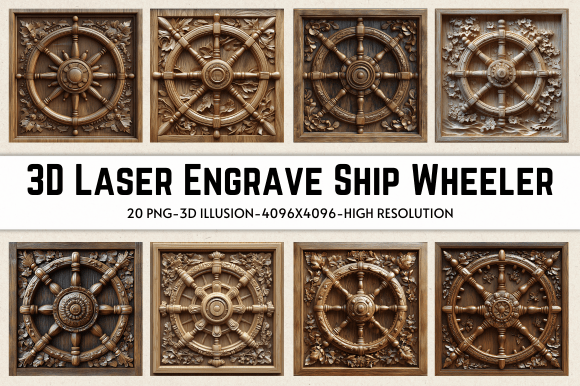
At its core, the 3D Laser Engrave Ship Wheeler is a collection of optimized PNG files that utilize grayscale data to create the illusion of three-dimensional depth on a two-dimensional surface. Unlike vector files (such as SVG or DXF) which rely on lines and shapes, this format relies on pixel intensity. The original grayscale image is processed so that the laser machine interprets darker pixels as areas requiring more power or slower speed, while lighter pixels receive less energy. This technique, often referred to as raster engraving, allows for intricate details like the rigging, hull texture, and sails of the Ship Wheeler to be rendered with photographic quality.
The specific package associated with this design typically includes a substantial zipped folder containing multiple variations. Buyers usually receive a mix of coloring PNGs and dedicated grayscale PNGs, all set against a transparent background. Each file is standardized at 13 x 13 inches or 4096 x 4096 pixels. This high resolution is critical because laser engravers do not "scale up" images without losing detail. By providing a large canvas, the 3D Laser Engrave Ship Wheeler ensures that even when resized to fit smaller materials, the pixel density remains sufficient to prevent banding or blurring in the final engraving.
Comparing Grayscale Raster Files to Vector Alternatives
When evaluating resources for laser engraving, creators often face a choice between vector-based designs and grayscale raster files like the Ship Wheeler. The decision largely depends on the desired aesthetic and the material being used. Vector files are excellent for cutting wood or acrylic and for creating crisp, outlined text or logos. They are editable and scalable without quality loss, making them ideal for geometric precision.
However, if the goal is to achieve a realistic, shaded portrait or a detailed scene like a sailing ship, vector files fall short. They cannot easily replicate the subtle gradients found in natural lighting or complex textures. This is where the 3D Laser Engrave Ship Wheeler excels. By utilizing a Jarvis dither filter—a common technique in lightburn software—the file breaks down continuous tones into patterns of dots that the human eye blends together. Compared to a standard black-and-white line drawing, the grayscale approach offers a dramatic increase in perceived depth and realism. While vector files offer flexibility in editing, the raster format offers superior visual fidelity for artistic projects.
Technical Considerations and Machine Compatibility
One of the most significant factors in successfully using the 3D Laser Engrave Ship Wheeler is ensuring compatibility with your specific hardware and software. Not all laser engravers handle grayscale images identically. The design is optimized for major platforms including Glowforge, xTool, and LightBurn, but the settings must be adjusted to match the machine's power output and lens focal length.
For users operating a Glowforge, the recommended workflow involves setting the speed to approximately 1000 mm/min and the power to around 90%. Crucially, the "Vary Power" setting must be enabled in the grayscale mode. This tells the machine to modulate the laser power based on the brightness of each pixel rather than just turning the laser on and off. Additionally, setting the Lines Per Inch (LPI) to 270 or higher can enhance the smoothness of the gradients, though this may increase processing time. It is also advisable to use lighter woods, such as birch plywood or basswood, as they provide a better contrast ratio for the darkened engraved areas compared to naturally dark or oily woods.
For those using LightBurn, the process often involves importing the PNG and applying a dithering algorithm if the software does not automatically recognize the grayscale map. The Jarvis dither filter mentioned in the product specifications is particularly effective for organic subjects like ships, as it reduces the "muddy" look that can occur with simpler thresholding methods. Users should note that while the file is ready for download, it is not editable in terms of altering the ship's structure. The buyer is responsible for resizing the design within their software to fit the chosen product dimensions. Attempting to stretch the image beyond its native resolution will degrade the quality, so careful planning of the workspace is essential.
Evaluating Strengths, Tradeoffs, and Best-Fit Situations
The primary strength of the 3D Laser Engrave Ship Wheeler lies in its versatility across various crafting mediums. Because the design is a high-resolution raster image, it translates well onto wood plaques, leather goods, slate tiles, and even certain textiles. For home decor enthusiasts, this file offers a quick path to creating gallery-worthy wall art without the need for advanced graphic design skills. The inclusion of both coloring and grayscale options adds another layer of utility; the coloring versions can be used for hybrid projects where the laser engraves the outline and shading, and the user fills in colors by hand or with markers.
However, there are tradeoffs to consider. The main limitation is the lack of editability. If you wish to change the name of the ship, remove a sail, or alter the perspective, you cannot do so directly within the PNG file. You would need to import the image into a photo editing suite like Photoshop or GIMP, which requires a different skill set. Furthermore, the file size—often totaling over 600 MB for the full package—requires adequate storage space and bandwidth for the initial download. Once downloaded, the individual files are manageable, but the bulk of the package suggests a comprehensive library rather than a single-use item.
This resource is best suited for makers who prioritize visual impact over structural customization. It is an ideal choice for small business owners looking to expand their catalog of nautical-themed gifts, stationery, or personalized awards. Conversely, if your project requires precise cutting paths or if you need to modify the underlying geometry of the ship, a vector-based alternative would be a more appropriate investment. The Ship Wheeler is a finishing tool, designed to add the final artistic touch to a substrate, rather than a blueprint for construction.
Decision Factors for the Modern Maker
Before purchasing or downloading the 3D Laser Engrave Ship Wheeler, potential users should assess their current workflow. Do you have a reliable source of light-colored wood? Are you comfortable adjusting LPI and power settings to test different materials? If you are new to laser engraving, the learning curve associated with dialing in the perfect grayscale settings can be steep. However, the provided instructions for machines like Glowforge serve as a solid starting point, reducing the risk of failed test runs.
Consider also the end product. If you are producing items for resale, consistency is key. The high resolution of these PNG files ensures that every piece you produce maintains the same level of detail, provided your machine is calibrated correctly. For personal projects, the ability to experiment with different passes and masking options allows for creative variation. The transparency of the background also facilitates easy placement on complex layouts, allowing you to combine the ship design with other elements like dates, names, or quotes.
In summary, the 3D Laser Engrave Ship Wheeler represents a specialized tool in the digital fabrication toolkit. It bridges the gap between digital art and physical craftsmanship, offering a level of detail that standard clip art cannot match. By understanding its technical requirements, comparing it to vector alternatives, and recognizing its specific strengths in grayscale rendering, creators can make an informed decision about whether this resource aligns with their project goals. Whether for a one-off gift or a production run, the quality and optimization of these files make them a valuable asset for anyone serious about laser engraving aesthetics.