Integrating the Baloon Hot Air Magnet Stl 3d Print into Your Creative Workflow
The landscape of digital fabrication has shifted significantly from complex, multi-part assemblies to streamlined, single-process solutions. At the forefront of this evolution is the Baloon Hot Air Magnet Stl 3d Print, a design that exemplifies efficiency and user-centric engineering. For professionals, hobbyists, and small business owners alike, this specific STL file represents more than just a decorative object; it is a functional asset designed to integrate seamlessly into existing production pipelines. Whether you are managing a home office setup, curating merchandise for an online store, or simply enhancing your personal workspace, understanding how to leverage this print-in-place design can save time and reduce material waste.
Understanding the Design Philosophy and Utility
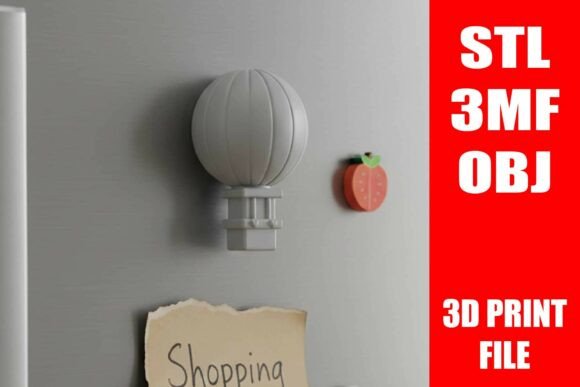
The Baloon magnet – STL File for 3D Printing Digital Download is engineered with a specific set of constraints in mind: simplicity, reliability, and aesthetic appeal. Unlike traditional 3D models that require post-processing, support removal, and manual assembly, this file utilizes a print-in-place mechanism. This means the internal moving parts—specifically the balloon shape that interacts with the magnetic base—are printed as a single unit. The geometry is clean and error-free, created using professional 3D software to ensure that tolerances are precise enough for smooth operation without being so tight that they jam during the printing process.
In a broader workflow context, this type of asset fits perfectly into the "rapid prototyping" or "small batch production" phases of a project. For entrepreneurs looking to test a new product line, the ability to print a high-quality item without tooling costs is invaluable. For educators, it serves as an excellent demonstration of mechanical principles within a fun, recognizable form factor. The design's reliance on a single color simplifies the decision-making process regarding material selection, allowing users to focus entirely on the mechanical outcome rather than color calibration or multi-material switching.
Preparation and Compatibility Considerations
Before initiating the print job, successful integration of the Baloon Hot Air Magnet Stl 3d Print requires careful preparation of the slicing environment. While the model is optimized for general use, specific hardware configurations yield the best results. The design has been rigorously tested using PLA on a Bambu Lab A1 Mini, providing a reliable baseline for settings. However, users with different printer brands should consider the following factors to ensure consistency and quality control.
Material Selection: PLA remains the ideal choice due to its dimensional stability and ease of printing. The thin walls required for the print-in-place movement demand a material that does not warp excessively under heat. If you are aiming for a more durable version for heavy-duty commercial use, PETG is a viable alternative, though you may need to slightly adjust the layer height and cooling fan speeds to maintain the delicate clearances between the balloon and the housing.
Slicer Settings: When importing the STL into your slicing software, pay close attention to the infill density. A standard 15% to 20% infill is usually sufficient for structural integrity while keeping weight low. The most critical setting involves the wall thickness and the number of perimeters. Since the magnet must slide freely, the slicer must interpret the internal gaps correctly. It is advisable to inspect the preview mode in your software to ensure no accidental bridging occurs across the moving joints. Additionally, enabling a "slow down at corners" feature can help prevent vibration-induced errors on the intricate curves of the hot air balloon basket.
Execution: From Digital File to Physical Asset
The execution phase is where the theoretical benefits of the Baloon Hot Air Magnet Stl 3d Print become tangible. Because the design eliminates the need for assembly, the workflow is drastically shortened. Once the print is complete, the only post-processing step typically required is the removal of any necessary supports (if your slicer generated them) and the insertion of the magnet itself. Some versions of the design may have a dedicated cavity for the magnet, requiring a simple press-fit, while others might rely on the friction of the printed plastic to hold the magnetic component.
This streamlined process allows for rapid iteration. If you are producing these for a client or a retail event, you can run multiple prints simultaneously on a larger bed printer or queue them up on a farm of smaller machines. The consistency of the geometry ensures that every unit functions identically, which is crucial for maintaining brand reputation if these items are part of a larger product offering. The "clean, high-quality geometry" mentioned in the design specifications translates directly to reduced failure rates, meaning fewer wasted hours troubleshooting failed prints.
Integration into Professional and Personal Workflows
For small business owners and freelancers, the Baloon Hot Air Magnet Stl 3d Print offers a versatile use case. It can serve as a premium giveaway item, a desk accessory for clients, or even a standalone product sold on platforms like Etsy or Shopify. The digital nature of the download means there is no inventory risk; you only produce what you need, when you need it. This aligns perfectly with lean manufacturing principles, reducing overhead costs associated with storage and unsold stock.
In an educational setting, this model provides a hands-on learning opportunity. Educators can guide students through the entire lifecycle of 3D printing, from selecting the file to analyzing the mechanics of the print-in-place joint. Students learn about tolerance management, material properties, and the importance of design for manufacturing (DFM). The visual appeal of the hot air balloon theme makes the technical concepts more engaging, bridging the gap between abstract theory and physical application.
For productivity-minded individuals, these magnets serve as functional organizers. They can be used to hold notes, receipts, or reminders on metal surfaces such as refrigerators, whiteboards, or filing cabinets. The novelty of the design adds a touch of personality to a sterile office environment, potentially boosting morale and creativity. The fact that it is a single-color print also means it can be easily matched to existing office decor by choosing the appropriate filament color.
Quality Control and Long-Term Usability
Maintaining quality over time is essential for any printed asset. The Baloon magnet – STL File for 3D Printing Digital Download is designed for longevity, but proper handling extends its lifespan. Since the moving parts are printed in place, they rely on the inherent strength of the polymer layers. Avoid exposing the finished product to direct sunlight for extended periods, as UV degradation can make PLA brittle over time, potentially causing the balloon mechanism to crack under stress.
Regular inspection of the moving joints is recommended. If the mechanism begins to feel stiff, a light application of dry lubricant, such as PTFE powder, can restore smooth movement without attracting dust. For those who plan to mass-produce these items, establishing a quality control checkpoint after every ten prints is advisable. Check the clearance of the balloon against the frame to ensure that thermal expansion during printing hasn't caused any subtle shifts in tolerance. Consistency is key to ensuring that every customer receives a product that functions exactly as intended.
Strategic Implementation Tips
To maximize the value of the Baloon Hot Air Magnet Stl 3d Print, consider the following strategic implementation tips:
- Batch Production: Group similar jobs together to minimize filament changes and machine setup time. This increases overall throughput and reduces energy consumption per unit.
- Color Coding: Use different filament colors to denote different categories or teams if using these magnets in a collaborative workspace. This turns a simple tool into a visual management system.
- Customization: While the core geometry is fixed, you can experiment with adding text or logos to the flat surfaces of the base using custom G-code or by modifying the STL before printing, provided you do not interfere with the moving parts.
- Documentation: Keep a log of your successful print settings. As you change printers or filament batches, having a reference point for what worked previously will save significant troubleshooting time.
By treating the Baloon Hot Air Magnet Stl 3d Print as a strategic asset rather than a one-off novelty, you unlock its full potential. It represents a convergence of digital convenience and physical utility, offering a practical solution for organization, education, and commerce. As you integrate this resource into your daily routine, remember that the true value lies not just in the object itself, but in the efficient, thoughtful process used to create and deploy it.